
The Node.js Event Loop Explained
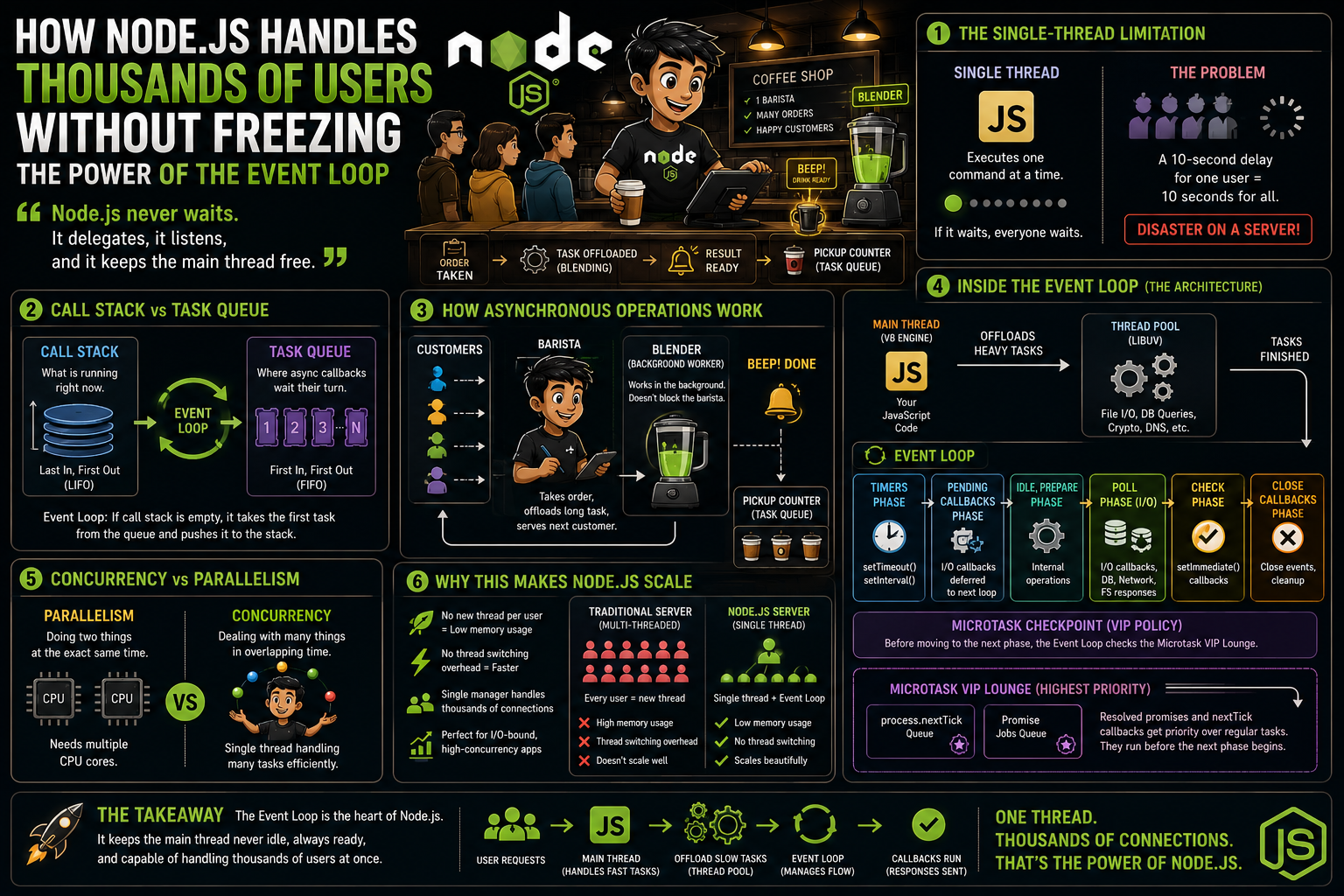
We all know JavaScript is a single-threaded language. This means it can only execute one command at a time. If you write a piece of code that takes ten seconds to run, the entire application freezes for ten seconds. Nobody else can log in, no buttons can be clicked, and no data can be fetched.
In a web browser, a frozen page is annoying. On a server, a frozen process is a disaster. If a single thread is handling thousands of users, a ten-second delay for one user means a ten-second delay for everyone. So how does Node.js handle massive amounts of traffic without freezing up?
The answer is the Event Loop.
The Single-Thread Limitation
To understand why the event loop is so important, you have to understand the limitation of a single thread. When you run a Node.js application, the engine allocates a single main thread to execute your JavaScript code.
If every database query or file system read happened directly on this main thread, your server would spend most of its time just waiting for external resources to respond. Node.js gets around this by offloading the slow, heavy tasks to the background. But once those background tasks are finished, the results need to get back to the main thread.
That is where the event loop comes in. It acts as the ultimate task manager, perfectly orchestrating what runs on the main thread and when.
Task Queue vs Call Stack
To see how this works in practice, let us look at two main concepts: the Call Stack and the Task Queue.
The Call Stack is a record of what your program is doing right at this exact moment. Think of it like a stack of plates. When a function starts, a plate goes on top of the stack. When the function finishes, the plate is removed. The main thread can only ever look at the plate on the very top.
The Task Queue is the waiting room. When an asynchronous operation finishes in the background, like a file being read, the callback function associated with it does not just shove its way onto the Call Stack. Instead, it politely takes a ticket and sits in the Task Queue.
The event loop has one simple job. It constantly looks at the Call Stack. If the Call Stack is empty, it looks at the Task Queue, takes the first callback waiting in line, and pushes it onto the Call Stack so the main thread can execute it.
How Asynchronous Operations Work
Let us tie this together with an analogy. Imagine a busy coffee shop with only one barista. This barista is your main thread.
If a customer orders a complex blended drink, the barista does not stop serving everyone else to blend it. Instead, the barista takes the order, passes the blending task to an automated machine in the back, and immediately takes the next customer's order.
When the blender finishes, it beeps. That beep is an event. The finished drink is placed on the pickup counter. The pickup counter is your Task Queue. The barista finishes taking the current order to clear the Call Stack, checks the pickup counter, and hands the blended drink to the customer.
Inside the Event Loop
If you look at the architecture diagram provided, you can see exactly how this flow is structured under the hood.
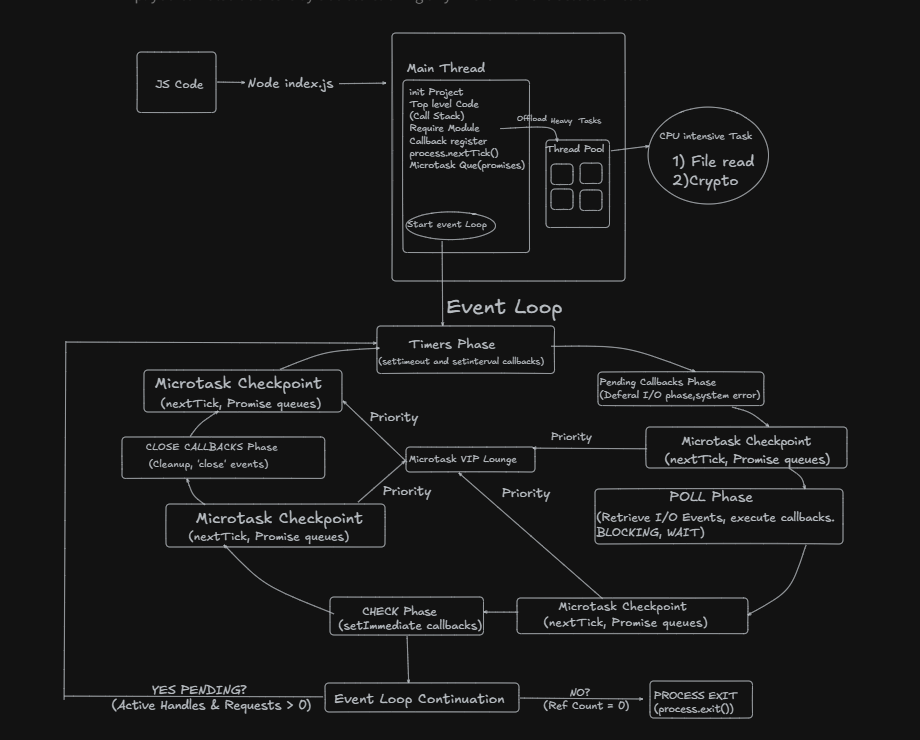
The Main Thread handles your top-level code. When it hits CPU-intensive tasks like reading a file or cryptography, it offloads them to the Thread Pool. Once the event loop starts, it does not just check one giant queue. It actually processes different types of callbacks in specific phases.
While we do not need to dive deeply into the internal C++ source code just yet, it is helpful to understand the high-level split shown in the diagram:
Timers Phase: This is where callbacks scheduled by
setTimeoutandsetIntervalare executed.Poll Phase (I/O): This is where most of your standard application work happens. When a database responds or a network request finishes, their callbacks are handled here.
You will also notice the "Microtask Checkpoint" and the "Microtask VIP Lounge" in the diagram. This is specifically for things like Promises and process.nextTick. The event loop has a strict VIP policy. Before moving from one major phase to the next, it always checks the microtask queues. If there are resolved promises waiting, they get priority access to the main thread over regular tasks.
Why This Makes Node.js Scale
The event loop is the entire reason Node.js scales so beautifully for I/O-heavy applications. By never waiting around for a database or a file system to respond, the main thread is always free to accept new incoming requests.
A traditional server architecture creates a heavy new thread for every user, which eats up memory fast. Node.js simply uses a single, highly efficient manager to juggle thousands of asynchronous tasks. It uses less memory, avoids the overhead of switching between thousands of active threads, and keeps your backend incredibly fast.


